
What Your Partner's Snoring Is Doing to Your Mental Health
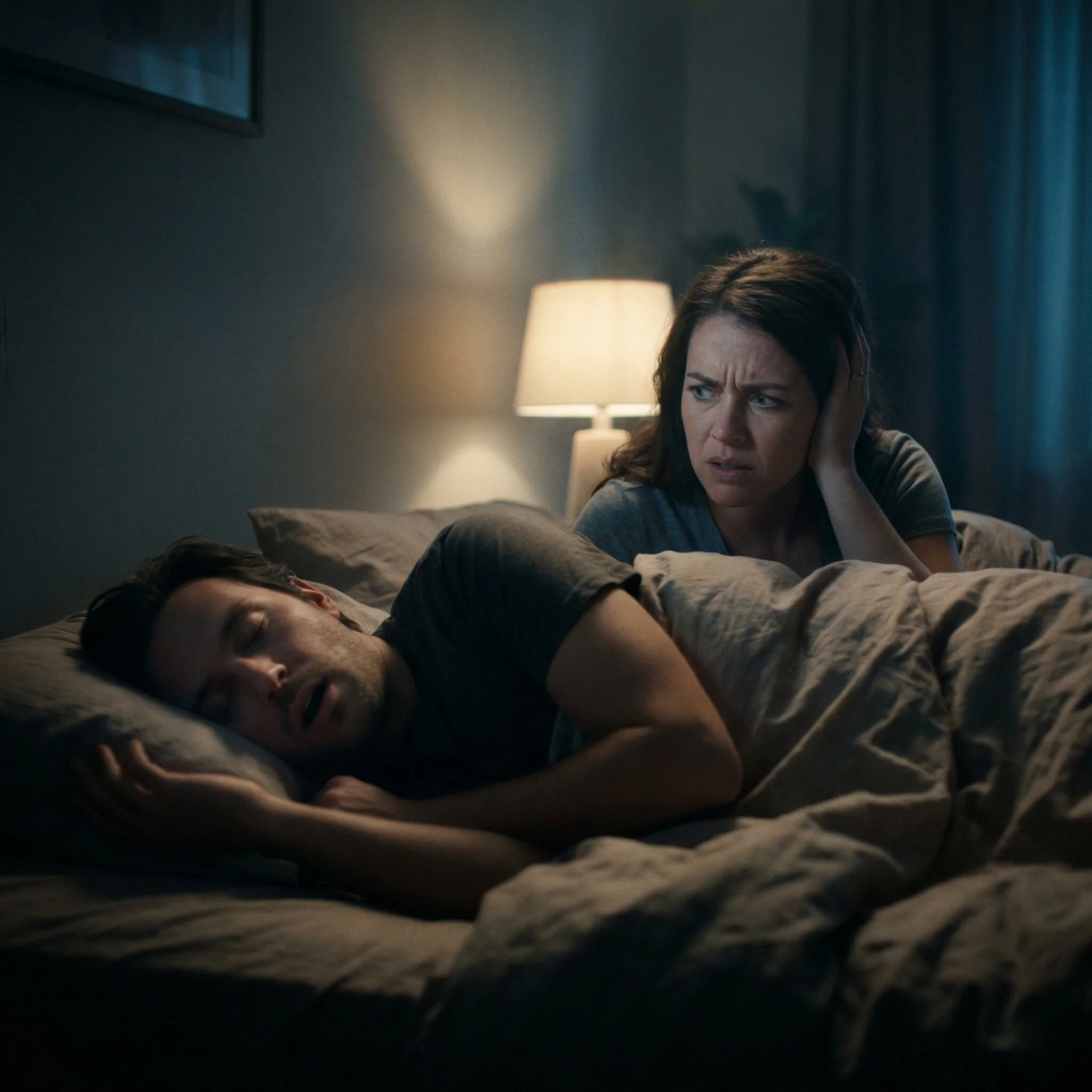
You go to bed tired. You wake up more tired. And somewhere between the hours of midnight and 5am, you have silently started resenting the person you love most. Not because of anything they said or did. Because of the sound they make when they sleep.
Snoring is one of those issues that gets dismissed with a laugh in polite conversation but causes real, measurable damage behind closed bedroom doors. If you have been lying awake night after night listening to your partner snore, you already know the frustration. What you may not know is that the damage goes significantly deeper than feeling groggy at work.
Sleep Deprivation Is Not Just Tiredness
When your partner snores loudly or unpredictably, your brain cannot complete its natural sleep cycles. Even if you technically spend eight hours in bed, the repeated micro-arousals caused by noise disruption prevent you from reaching the deep restorative sleep stages your brain and body depend on.
The consequences of this chronic sleep fragmentation are not trivial. Research consistently links poor sleep quality to elevated cortisol levels, reduced emotional regulation capacity, impaired memory consolidation, and significantly increased risk of anxiety and depression. You are not being dramatic when you say the snoring is affecting your mental health. You are describing a physiologically real process.
The part that makes this particularly difficult is that the damage accumulates slowly. One bad night is recoverable. Months or years of disrupted sleep changes your baseline. Your threshold for stress drops. Your patience shortens. Your mood becomes harder to regulate. And because the cause is ambient rather than dramatic, it is easy to misattribute the symptoms to everything else in your life.
What It Does to the Relationship Itself
The mental health impact of a snoring partner is not limited to sleep deprivation alone. The relational dynamics that develop around chronic snoring can be just as damaging as the lost sleep itself.
Partners of heavy snorers frequently report sleeping in separate rooms, which can erode intimacy and connection over time. They report feeling guilty for being resentful of something their partner cannot control. They experience the particular exhaustion of a problem that is real and serious but somehow never quite serious enough to address directly.
That guilt and resentment cycle is a genuine mental health burden. Feeling angry at someone you love for something involuntary creates cognitive dissonance that, left unresolved, breeds emotional distance. Couples who never address the snoring often find themselves addressing the distance years later without fully understanding where it came from.
When Snoring Is More Than Just Noise
Here is the piece of information that changes the conversation entirely. Chronic loud snoring is one of the primary warning signs of obstructive sleep apnea, a condition in which the airway repeatedly collapses during sleep, causing the sleeper to stop breathing momentarily. The snorer is not just making noise. In many cases they are gasping for oxygen dozens or hundreds of times per night without knowing it.
This means that while you are lying awake losing your mental health one disrupted night at a time, your partner may be losing their cardiovascular health, cognitive function, and long-term wellbeing on the other side of the bed. The snoring is not just your problem. It is a clinical warning sign that deserves a clinical response.
The good news is that solutions have come a long way beyond CPAP machines that patients abandon within weeks. Practices like Sleep Solution Centers in Orlando offer non-surgical, CPAP-free treatment options including custom oral appliances, laser therapy, and nasal breathing techniques that address the root airway causes of snoring without the discomfort and compliance issues that have historically made sleep apnea treatment so difficult to sustain.
The Conversation Worth Having
If you have been avoiding bringing up the snoring because it feels like an accusation or because every previous conversation has gone nowhere, reframing it as a health concern rather than a complaint changes the dynamic entirely.
This is not about the noise keeping you awake. It is about the fact that your partner may be oxygen deprived every single night and the both of you deserve actual restorative sleep. That framing tends to open doors that frustration and exhaustion keep firmly shut.
Your mental health is not a small thing to sacrifice for the sake of avoiding a difficult conversation. Neither is your relationship.
Organizations working with health-focused digital strategy firms like Infinite Labs Digital to raise awareness around conditions like sleep apnea are helping more people recognize the signs earlier and take the first step toward treatment before the relational and mental health consequences become harder to reverse.
The bedroom should be a place of rest. For both of you.
